


AAC Mix Design for Different Climates: Step-by-Step Guide
AAC mix design for different climates is a plant-level engineering decision, not a standards-mandated one. EN 771-4 sets a durability clause for autoclaved aerated concrete, the lightweight cellular material formed when a silica source such as sand or fly ash reacts with calcium from lime and cement under autoclaving to produce calcium silicate hydrates that carry strength (IJRESM, 2025), but it publishes no climate-zone performance class. So the recipe you run in Rajasthan cannot simply be copied to coastal Vietnam or a Kazakh winter.
There is a baseline to move from. A typical AAC dry mix runs roughly 50 to 70 percent silica source, 15 to 30 percent lime, 5 to 15 percent cement and 2 to 5 percent gypsum, with water-to-solid often around 0.6 to 0.65 (IJRESM, 2025). This guide covers four zones, hot-arid, humid and tropical, cold and freezing, and high-altitude or temperate, and gives a quantified adjustment and a verification test for each.
This guide is published by Teeyer, which has specialized in the AAC industry since 1989 and has built more than 1,200 production lines across 30 countries. Its in-house teams handle raw material analysis, customized chemical formulation, and process optimization for AAC producers, which is the work this article draws on when discussing mix design adjustments for different climates.
Prerequisites: What You Need Before Adjusting the Mix
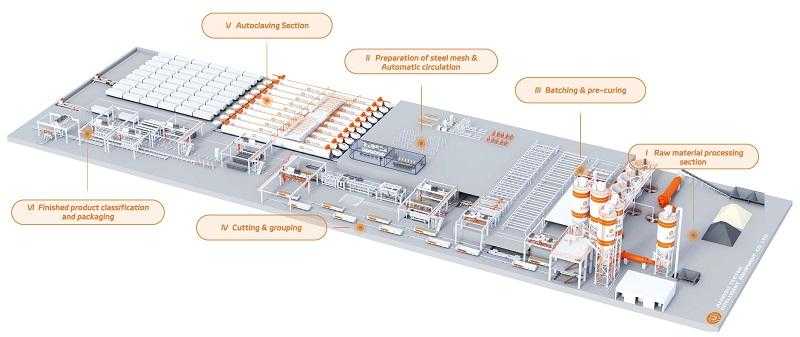
Before you touch a single parameter, assemble three inputs: a current raw-material analysis of your own silica source, lime, cement and gypsum; your autoclave's achievable pressure and cycle capability; and at least one full year of local climate records.
Each input maps to a job in the reaction. Your silica source, whether sand or fly ash, supplies the SiO₂ that reacts with calcium during autoclaving to form the calcium silicate hydrates that carry strength (IJRESM, 2025). Lime is the main reactive calcium source, cement provides the green strength needed for cutting and handling before autoclaving, and gypsum regulates set (Zihan Technology). Change any one of them and the others shift with it, which is why the analysis comes first.
Start from the baseline dry-mix range reported in AAC composition literature: roughly 50–70% silica source, 15–30% lime, 5–15% cement, 2–5% gypsum, with water-to-solid around 0.6–0.65 (IJRESM, 2025). Treat it as a starting envelope, not a recipe.
Aluminium dosage is where published figures diverge, and you need to know that before you batch. One plant-level trial recipe reports aluminium powder dosage at 0.05–0.08%, while a peer-reviewed study on autoclaved aerated concrete gives 0.1–0.25% of the weight of dry materials (Springer, 2022). That is roughly an order of magnitude apart, and the two sources are not necessarily measuring the same base. Fix your own base by trial mix before any climate adjustment.
Pro Tip: Run one control batch at your standard dosage and record the base you measured against (total dry solids or silica source alone). Every climate adjustment later in this guide is a delta from that number, so an ambiguous base will corrupt the whole series.
DIAGRAM: labelled batching-and-autoclave line layout, raw-material analysis → water dosing → aluminium dosing → pressure vessel
Time: 2–3 weeks for analysis turnaround and a control batch. Difficulty: Intermediate. You should be comfortable reading a mix design sheet and running a trial batch through your own autoclave cycle.
Step 1: Fix the Baseline Mix and Curing Regime Before You Change Anything
By the end of this step you will have one documented baseline recipe and one documented autoclave curve, and every climate adjustment in the steps that follow gets measured against them. Without a recorded starting point, you cannot tell a real improvement from batch noise.
Record the following on a single form for at least three consecutive production batches:
Batch weights for every raw material, including aluminium powder, at the plant's standard density class.
Slurry temperature and rising height at the point of casting.
Autoclave pressure curve, logged against time rather than recorded as a single peak value.
Cube results from the same batches, tested to the density class you declare.
For the curing regime, typical plant autoclave cycles run on saturated steam at roughly 1.0 to 1.3 MPa and 180 to 200 °C, with a total cycle of about 10 to 18 hours of which 6 to 12 hours is constant-pressure soak. Published research on AAC curing covers windows of 5 to 24 hours at 160 to 208 °C and 6 to 18 atm, and that same body of work found no standardised climate-based autoclave schedule exists. Treat that as your reference envelope, not a universal schedule: published research windows span 5 to 24 hours at 160 to 208 °C and 6 to 18 atm, and that same body of work found no standardised climate-based autoclave schedule exists. Your baseline curve is therefore a plant-specific decision that you document, not one you inherit from a table.
Anchor the baseline to the standards you already sell against. EN 771-4 sets the declared density and strength floor, allowing a tolerance of ±50 kg/m³ on declared density with a minimum compressive strength of 1.5 N/mm². ASTM C1693 grades AAC-2, AAC-4 and AAC-6 at 2.0, 4.0 and 6.0 MPa. India's IS 11239 density grades run Grade 1 through Grade 4. Whichever framework your market uses, write the applicable floor on the same form as your batch data.
Verify: a baseline cube set at the plant's standard density class, tested and recorded, that later steps can be compared against directly.
Step 2: Adjust the Mix for Hot-Arid Climates
In hot-arid conditions the governing risk is water loss and premature stiffening before the mix reaches the mould, so the adjustment belongs to batch water and slurry temperature, not to cement content. The evaluation criterion this step satisfies is workability retention under high evaporation.
The mechanism is that fine feedstocks behave as variable-water materials, so their moisture content shifts with storage and ambient conditions and must be measured frequently enough to correct both batch water and solids weights. In practice: cool the batch water, shorten the mixing-to-pour window, and correct the silica source moisture before weighing rather than after the slurry stiffens.
Aim for a casting slurry temperature a few degrees below your humid-climate set point and hold the water-to-solid ratio inside the 0.6–0.65 band rather than at its upper edge, since evaporation will pull the effective value down before the mix reaches the mould. Treat the exact target temperature as a trial-mix variable set against your own rising-height curve, not a fixed number.
Verify by logging slurry temperature at discharge and checking rising height against the Step 1 baseline. If rising height falls short while slurry temperature is in range, the cause is moisture correction, not cement.
Step 3: Adjust the Mix for Humid and Tropical Climates
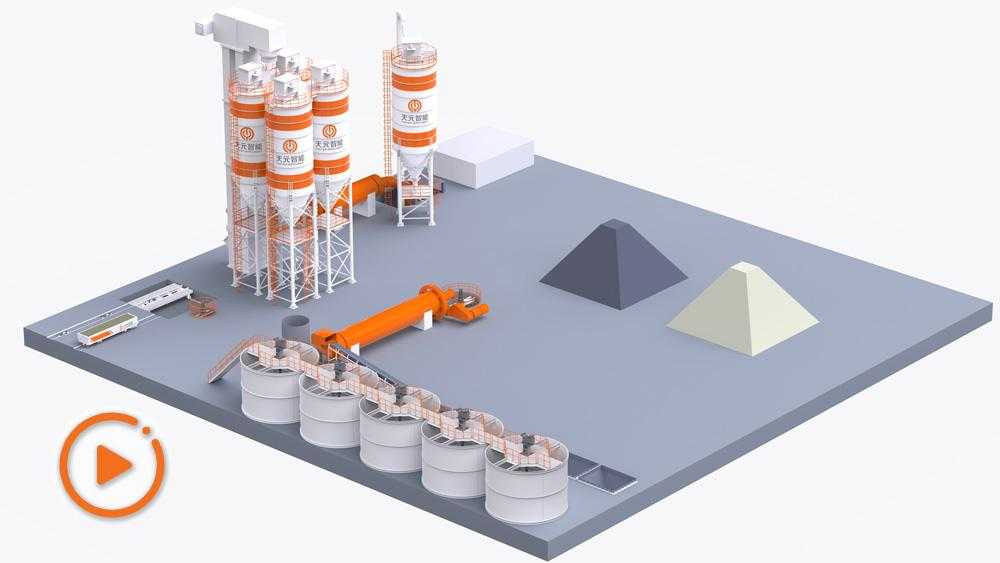
In humid and tropical conditions the governing risk is not the recipe but the water that arrives with the raw materials, so the evaluation criterion is batch-to-batch consistency of effective water. Quicklime is the main offender: it begins hydrating in storage, so the CaO you weighed is not the CaO that reaches the mixer. Fine feedstocks behave the same way, acting as variable-water materials whose moisture drifts with ambient humidity and rainfall.
The adjustment is storage discipline plus a corrected water-to-solid ratio. Keep quicklime in sealed silos on strict FIFO rotation with short dwell times, and apply a moisture-correction factor to both the water and the solids weights rather than to water alone. The non-obvious detail behind rising-height scatter is the expanding agent's form: aluminium dust causes rapid stiffening of the fresh paste, while aluminium powder does not, so two suppliers at the same nominal AAC aluminium powder dosage can produce different rising behaviour.
Verify: compare rising height and green-cake cut time against baseline across ten consecutive batches.
️ Warning: Unsealed quicklime storage and long silo dwell times silently change your effective water and CaO content. Probe incoming sand and fly ash moisture every shift, not every week.
Step 4: Adjust the Mix for Cold and Freezing Climates
In cold and freezing conditions the governing risk is retarded early strength, so the adjustment is heated batch water plus a non-chloride accelerator, with the cement fraction raised only as far as the trial mix proves necessary. The evaluation criterion is green strength sufficient for cutting and handling before autoclaving, because cement gives the green strength needed for cutting and the cake must survive the cutter and the transfer to the autoclave before curing ever begins.
Cold-weather concrete practice transferred to AAC gives the thresholds to work against: below roughly 10 °C early strength development becomes unfavourable, below about 4 °C it is greatly retarded, and at freezing little or no strength develops. Calcium chloride is not the answer where corrosion risk exists, since chloride accelerators attack reinforcement and handling equipment.
No independent test data on cold-climate AAC mix adjustment was found in this review, so treat the cement increase as a trial-mix variable rather than a rule of thumb. Heat the water, dose a non-chloride accelerator, then raise cement in small increments until the green cake cuts cleanly and holds its edges against your baseline.
Step 5: Adjust the Mix and Curing Regime for High-Altitude and Temperate Conditions
At altitude, the variable that governs your autoclave curing regime for AAC is absolute pressure, not the gauge reading. A plant at 2,000 m sits in a thinner atmosphere, so the same gauge value delivers less absolute pressure inside the vessel, and that shortfall shows up as weaker, more porous block.
A study of aerated concrete cured under simulated high-altitude pressure quantified the correction: raising curing pressure from 1.2 to 1.3 MPa cut total porosity from 73.71% to 67.30% and lifted compressive strength from 4.1 to 5.1 MPa. The same work found the pressure effect outweighed the time effect, so extend the constant-pressure soak only after you have raised absolute pressure.
Low ambient pressure also lowers water's boiling point, accelerating moisture loss and risking incomplete hydration if the cure is not controlled. Verify against your Step 1 baseline: cube strength, porosity, and a pressure-curve log review.
Key Takeaway: Set your autoclave target in absolute pressure, not gauge. At altitude the two diverge, and the gap is large enough to cost you strength.
Step 6: Verify Results and Read Them Against Plant Economics

The adjustment is finished only when the cube results and the plant's commercial metrics move together. Cut one cube set per climate recipe at the same age you use for routine release testing, and check density against EN 771-4's ±50 kg/m³ tolerance and strength against the declared class before you accept the batch.
Then read the numbers the plant is judged on. Reject rates reported for manual-batching plants run about 8% to 15%, while roughly 80% capacity utilisation is often used as a financial-model assumption in a 300 CBM/day project case. Treat that utilisation figure as a model input rather than a measured industry average. Track reject rate, unit cost and capacity utilisation per climate recipe, not per plant.
Verification check | Target | Read against |
|---|---|---|
Cube sets per climate recipe | One set at routine release age | Declared strength class |
Density tolerance | ±50 kg/m³ (EN 771-4) | Recipe baseline |
Reject rate | Below the manual-batching band | Unit cost |
Capacity utilisation | Model assumption, not benchmark | Throughput |
For plants that want the formulation work done upstream, Teeyer starts from a raw-material analysis of the customer's local sand, fly ash, slag or tailings and derives a customized formulation intended to hold quality while minimising cement consumption, with delivery experience across India, the Middle East, Central Asia, Southeast Asia and Russia.
Common Mistakes to Avoid
Averaging the two published aluminium dosage figures. The literature gives AAC aluminium powder dosage as roughly 0.05–0.08% in one source and 0.1–0.25% in another, and the two aluminium dosage figures sit on different bases, so they are not interchangeable. Averaging them produces a number that matches neither. Fix the base first: state whether the percentage is of total dry solids or of cementitious binder, then confirm it by trial mix on your own sand or fly ash.
Raising cement content to solve a water problem. Extra binder hides a slurry that is too wet or too coarse rather than correcting it. Check the water-to-solids ratio and the lime-to-silica balance before you touch cement.
Copying an autoclave schedule from a plant at a different altitude. Saturated-steam temperature and pressure relationships shift with elevation, so a schedule that cured correctly at sea level will not reproduce at 1,500 m. Recalculate from your own pressure and temperature readings.
Skipping moisture correction in humid conditions. Sand and fly ash carry free moisture that changes the effective water content. Measure it and correct the batch, or density and strength will drift.
️ Warning: Do not average the two published aluminium dosage figures. They are quoted on different bases, and the disagreement is a documented gap in the literature, not a range to split.
Troubleshooting When the Adjusted Recipe Still Misses Target
If density and strength both drift after a climate adjustment, work through the variables in a fixed order so you change one thing at a time. Check the aluminium dosage base first, since a dosage quoted against total dry solids and one quoted against cementitious binder are not the same number. Next confirm moisture correction was applied to both the water and the solids weights, not water alone. Then verify cube specimens were tested at the density class and age you declare, because a mismatch there reads as a strength failure when it is really a testing error. Only after those three checks should you touch cement content, the autoclave curve or the lime-to-silica balance.
Record the outcome of each trial on the same form you built in Step 1. A failed trial that is documented still tells you which lever moved the needle; an undocumented one just costs an autoclave cycle.
Frequently Asked Questions
Frequently Asked Questions
Can one AAC mix design serve every climate zone?
No. A recipe tuned for a hot-arid plant will under-expand in a cold plant, and the reverse over-expands and cracks. The underlying reason is that no standardised climate schedule exists to copy from: mix design and curing regime are set per plant, from local raw materials and local conditions, which is why the parameter table in Steps 2 to 5 is organised by climate zone rather than as a single universal recipe. If you operate in more than one zone, treat each plant as its own baseline.
How long does a climate-adjusted recipe take to validate by trial mix?
Plan on a full production cycle per iteration, not a bench test. A trial mix is only conclusive once the cast cakes have been through the autoclave and the cured blocks have been tested for density, strength and dimensional stability, so each iteration costs one autoclave cycle plus the curing and testing time that follows it. Expect several iterations before the dosage and regime settle, and budget the trial material and autoclave capacity accordingly.
What if the autoclave cannot reach the required absolute pressure?
Then the mix cannot be fixed by chemistry alone. Raising aluminium dosage to compensate for low pressure pushes expansion without the strength to hold it, and the result is a block that meets density but fails strength. The workable options are to extend the constant-pressure hold at the pressure you can reach, to accept a lower strength class and sell against that specification, or to treat autoclave capability as the constraint the plant is designed around.
Is aluminium dosage or the curing regime the stronger lever?
Curing regime, in most cases. Aluminium dosage sets how much the mix expands, but the autoclave decides whether that expansion turns into strength: pressure, hold time and the temperature curve govern the tobermorite formation that gives AAC its load-bearing capacity. Change the regime first when a plant underperforms, then trim aluminium dosage to match the density and strength the regime can actually deliver.
Conclusion
You now have a documented baseline mix and curing regime, plus four climate-specific parameter sets, each with its own verification checkpoint. That is the working asset here: not a single recipe, but a repeatable method for adjusting AAC mix design for different climates and proving the adjustment worked before it reaches full production.
The payoff shows up in three numbers you already track: reject rate, unit cost and capacity utilization. A parameter set that holds density and strength control through the local wet or dry season keeps reject rates flat, holds cement consumption at the low end of its range, and keeps autoclaves cycling instead of waiting on rework.
Treat the values in this guide as starting points. Final aluminium powder dosage, water-to-solids ratio and curing schedule depend on your own sand, fly ash, slag or tailings, and only a raw-material analysis and trial mix can fix them.
If you would rather not run that trial-and-error alone, talk to a Teeyer engineer about raw-material testing, or compare plant configurations against your target output and climate before you commit capital.


