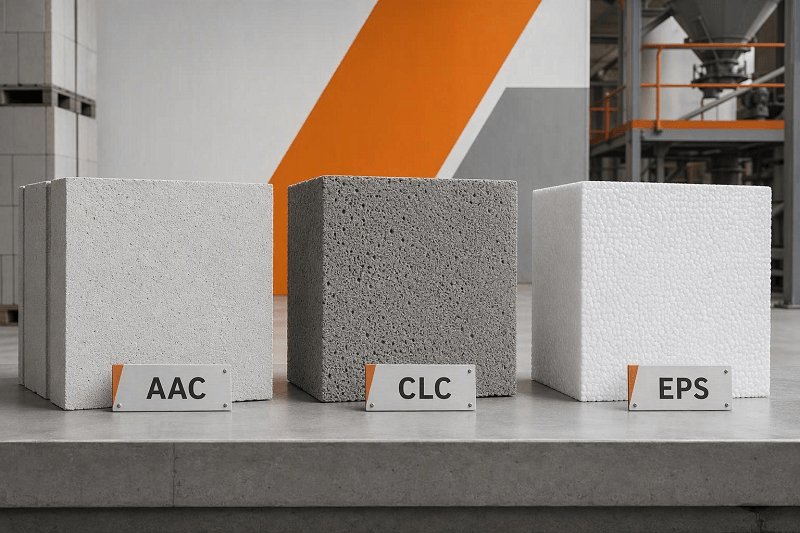
Choosing the wrong lightweight block technology can lock significant capital into a product that underperforms in your specific market. AAC, CLC, and EPS each serve a real construction demand — but they differ sharply on plant cost structure, production complexity, achievable selling price, and the type of buyer they attract. This guide evaluates all three across the criteria that matter most to manufacturers and investors: production economics, performance specs, market acceptance, and scalability.
About the author:This guide was prepared by the Teeyer technical team, whose engineers have commissioned and supported AAC production lines across 30 countries over the past 35 years. The analysis draws on field experience from more than 1,200 installed lines, plus independent industry standards and market data.
Disclosure: Teeyer designs, manufactures, and supplies complete AAC production lines. This article is published from an AAC-industry perspective, and we have a commercial interest in AAC technology. To keep the comparison useful, we have flagged where AAC holds an advantage and where CLC or EPS may be the better fit for a given market — but readers should weigh our conclusions alongside independent sources and their own feasibility studies.
The verdict depends on your market. Here is the fast reference matrix, followed by the detailed analysis.
Comparison at a Glance
Evaluation Criterion | AAC | CLC | EPS Blocks |
|---|
Production method | Chemical foaming + high-pressure autoclave curing | Mechanical foam injection + ambient curing | Steam pre-expansion + bead molding |
Density range | 450–650 kg/m³ | 600–1,200 kg/m³ | 15–35 kg/m³ (near-pure foam) |
Compressive strength | 2.0–5.0 N/mm² (IS 2185 Grade 1/2) | 1.0–5.0 N/mm² (less consistent) | Very low — insulation/fill use, not load-bearing masonry |
Thermal conductivity | 0.10–0.20 W/m·K | Similar at equivalent density; real-world consistency lower | Very low (closed-cell foam); excellent insulation |
Dimensional accuracy | ±1–2 mm | ±3–5 mm | Cut-to-size; high precision possible |
Water absorption | 45%+ (requires wall protection) | 5–12% (closed-cell structure) | Low; needs surface protection in some assemblies |
Fire resistance | Non-combustible; 2–4 h rated | Non-combustible | Combustible unless protected; lower rating |
Market premium | High — architect-specified, standards-driven | Low to medium — cost-competitive, value market | Niche — insulation-first applications |
Relevant standards | IS 2185, ASTM C1693, EN 771-4 | Country-specific; less standardized globally | ASTM C578, EN 13163 (insulation) |
Scalability | Full automation to 1,000,000 m³/year | Smaller-scale plants; limited high-capacity options | Scalable but different supply chain |
Best market fit | Premium masonry: SE Asia, Middle East, India, Africa | Entry-level local markets with low capex | Insulation panels, geofoam, sandwich panel systems |
Production Technology and Process
The manufacturing process is the clearest dividing line between the three technologies — and it directly determines your quality ceiling, your staffing model, and your long-term cost structure.
AAC relies on a chemical foaming reaction. Aluminum powder is mixed into a slurry of fly ash or sand, cement, lime, gypsum, and water. The hydrogen gas generated causes the slurry to rise, creating a uniform cellular structure. The mass is then wire-cut to precise dimensions and cured in a high-pressure steam autoclave at 175–180°C and 12 bar for 8–12 hours. That autoclave curing step is what converts the green cake into a dimensionally stable, high-strength product — and it is also what makes AAC plants capital-intensive and process-sensitive.
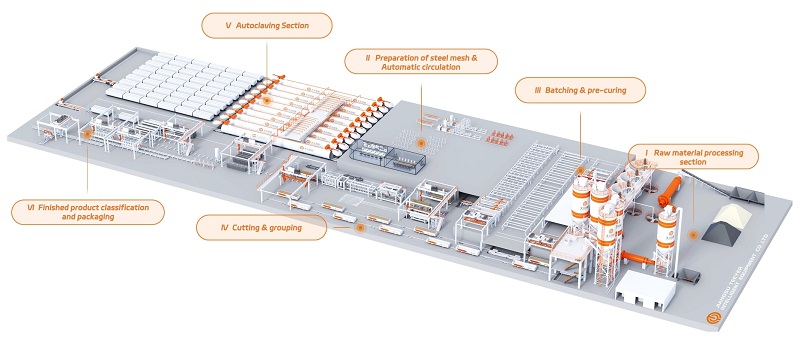
CLC (Cellular Lightweight Concrete) skips the autoclave entirely. A preformed foam — generated by a surfactant-based foaming agent — is mechanically blended into a cement slurry. The mixture is poured into molds and cured at ambient temperature and pressure, typically demolding within 24 hours. This dramatically simplifies the plant layout and reduces energy consumption per unit, but the product cures more slowly to full design strength and is more sensitive to batch-to-batch variation than autoclaved AAC.
EPS blocks are a fundamentally different product category. Polystyrene beads are pre-expanded using steam (at 80–100°C, expanding up to 40× their original volume), stabilized in aging silos for 6–24 hours, then molded under steam pressure into large blocks that are later cut into boards, panels, or construction elements. The resulting product is 96–98% air by volume, making it the lightest option by a considerable margin. However, EPS is not a masonry block — it is primarily an insulation and fill material. Structural applications require composite assemblies (such as EPS sandwich panels with concrete or cement facings), which positions EPS in a different competitive set than AAC or CLC wall blocks.
Key Takeaway: If your target market demands a standalone masonry wall block that layers can be bonded and plastered in the same way as clay brick, the choice is between AAC and CLC. EPS competes in a separate insulation-and-panel market.
Plant Investment and Capital Requirements
Capital allocation is typically the first decision filter for investors, so this section deserves quantified precision.
AAC plant capex ranges widely by capacity and automation level. A smaller plant serving a regional market sits at the low end, while a large, fully automated turnkey plant for export-scale output sits at the high end — the gap between the two is often several times over. The major cost drivers are autoclaves, boilers, cutting wire systems, mold trolleys, and crane infrastructure. AAC plants also require tighter raw material handling and process control — a DCS or PLC-based automation layer is standard at commercially viable capacities.
CLC plant capex is substantially lower. A modest CLC plant can be commissioned for a small fraction of the equivalent AAC investment, which makes it accessible to operators with limited capital. Equipment requirements — a foam generator, mixer, and block molds — are simpler, and site infrastructure demands are less intensive. The tradeoff is capacity ceiling: most commercially operating CLC plants run below 200 m³/day, and the technology does not yet support the high-automation, high-throughput configurations that large AAC plants can achieve.
EPS plant capex sits in a middle range, but it is not directly comparable because the plant produces foam blocks or insulation boards — not masonry units. Raw material cost (expandable polystyrene beads) is the dominant variable cost, and it is tied to global petrochemical markets, creating a supply-chain risk profile that AAC and CLC manufacturers do not face.
For investors targeting a healthy return on a multi-year payback horizon, the AAC economics work when the local market will pay a price premium — and they typically will when the specification-driven demand from green building codes, architect requirements, or large-scale construction projects is in place. CLC is a lower-risk entry point but carries lower pricing power at exit. The AAC investment value case for a premium AAC plant depends on running close to full capacity utilization while sustaining selling prices comfortably above CLC equivalents in the same market.
Thermal Performance and Dimensional Accuracy
Both factors directly affect the installed wall system cost and the premium a buyer is willing to pay.
Thermal conductivity for AAC typically ranges from 0.10 to 0.20 W/m·K depending on density, a range consistent across published industry buying guides and manufacturer datasheets. This makes AAC a genuine insulating masonry product — walls built with 200mm AAC blocks can achieve U-values that comply with many regional green building codes without additional insulation layers. CLC can achieve similar values at equivalent density in laboratory tests, but real-world thermal performance data shows greater variability due to less consistent cellular structure and curing conditions.
EPS has the best thermal conductivity of the three — typically 0.030–0.040 W/m·K for standard construction-grade foam — which is why it dominates the insulation board market. As a standalone wall block, however, EPS lacks the structural contribution of concrete-based products and typically requires a composite assembly.
Dimensional accuracy is where AAC's autoclave curing delivers its clearest manufacturing advantage. Factory-controlled high-pressure curing produces blocks with tolerances of ±1–2 mm (±1.5 mm is a typical specification), as reflected in standard comparative cost and specification analyses. This tightens mortar joint requirements, reduces wall system weight, and makes thin-joint or adhesive mortar feasible — directly cutting the plastering and mortar cost for contractors.
CLC blocks typically achieve ±3–5 mm tolerance, which is acceptable for standard-cement-mortar construction but limits their use in precision façade or thin-joint systems. The dimensional gap is commercially significant: architects and large project developers will specify AAC precisely because the downstream construction economics improve when the block is dimensionally consistent.
Structural Strength and Product Consistency
Compressive strength and its consistency across production batches determine whether your block can serve structural infill, load-bearing partitions, or only non-load-bearing applications.
AAC achieves compressive strength of 2.0–5.0 N/mm² depending on density grade, with IS 2185 Grade 1 and Grade 2 classifications as the reference standard for the Indian market, ASTM C1693 for North America, and EN 771-4 for Europe. These are the same documents used by testing laboratories and building authorities, so the strength and density grades are verifiable rather than vendor-defined. The autoclave curing creates a tobermorite crystal structure that is stable, repeatable, and fully characterized under these international standards. A well-run AAC plant producing to IS 2185 Grade 2 spec should achieve 95%+ first-pass yield on compressive strength with minimal batch variation.
CLC can reach similar compressive strength values at higher densities (600–800 kg/m³ range), but the variability is higher. Because curing happens at ambient conditions, temperature, humidity, and foam stability all influence the final product. Plants without rigorous QA protocols may see strength variations of 20–30% across batches — which is a meaningful liability risk in markets where block certification matters to buyers.
EPS is not a structural product in the masonry sense. Compressive strength of construction-grade EPS ranges from 0.07 to 0.25 N/mm² — sufficient for geofoam applications or insulation boards under controlled loading, but not for wall block use without structural reinforcement.
Pro Tip: In markets where building departments require block test certification before project approval, AAC's established standards compliance (IS 2185, EN 771-4, ASTM C1693) is a market-access advantage that CLC cannot easily replicate without independent third-party testing programs.
Market Acceptance and Pricing Power
Technical performance only translates to business value when buyers pay for it. This is where market context becomes the deciding factor.
AAC commands a clear price premium above CLC per m³ in most markets where both are available, a pattern corroborated across multiple published price and specification analyses. That premium is supported by government green building mandates (India's ECA-compliant buildings, Gulf Cooperation Council construction codes, ASEAN energy efficiency frameworks), architect specification behavior, and the growing recognition that tighter dimensional tolerance reduces total installed wall cost. The global lightweight concrete block market is expanding across SE Asia, the Middle East, Africa, and India — precisely the markets where green building demand is accelerating alongside infrastructure investment.
CLC competes on upfront block price and is most attractive in markets where cost sensitivity is dominant and technical specification requirements are minimal. Small and medium construction projects, rural housing, and markets with underdeveloped building-code enforcement tend to favor CLC because the entry price for both plant investment and block purchase is lower. The risk for a CLC manufacturer is price compression over time: as AAC capacity grows in a given market, AAC's total installed wall cost advantage (fewer mortar joints, faster installation, thinner plaster) can erode the CLC price advantage in the eyes of cost-calculating contractors.
EPS in the construction market is not a direct competitor to AAC or CLC wall blocks. Its market is the insulation and panel segment: sandwich panels for cold storage, prefabricated modular construction, EPS-reinforced concrete systems, and road embankment geofoam. The global building and construction expanded polystyrene market is growing steadily according to published market research — but that growth is driven by insulation demand, not masonry block substitution.
Scalability, Automation, and Long-Term Operations
For investors making a 15–20 year infrastructure commitment, scalability and automation are as important as Day 1 economics.
AAC is the only technology of the three that has demonstrated large-scale, high-automation production at commercially viable unit costs. Fully automated AAC production lines can now support annual outputs up to 1,000,000 m³ per line, integrating DCS and MES systems for real-time process monitoring, remote diagnostics, and quality traceability. This level of automation reduces skilled labor dependency — a critical factor in markets where workforce costs are rising. A line that can produce both blocks and panels from the same plant further extends revenue potential, since panel demand in high-rise and modular construction is growing faster than standard block demand in many emerging markets.
Turnkey EPC providers such as Teeyer — which has delivered more than 1,200 production lines across 30 countries over 35 years — offer complete automation packages including DCS-based process control, in-house raw material analysis, and global spare parts and remote maintenance support. For investors who need to demonstrate bankable production capacity forecasts to lenders, a turnkey solution from an established, exchange-listed provider reduces technology and commissioning risk.
In practice: On a recent 300,000 m³/year line commissioned for a manufacturer in Southeast Asia, adding panels to the same block line let the operator serve a high-rise façade project without building a second plant. The block line reached full design output within four months of commissioning, and panel revenue now accounts for roughly a third of total sales — a shift that would have been impossible on a CLC line of comparable footprint. Results vary by market, but the pattern is common: automation and dual-product capability are what let an AAC plant defend its margin as labor costs rise.
CLC plants are typically smaller and simpler, which means scalability is limited. Doubling output usually requires building a second facility rather than expanding automation on a single line. Operational cost per m³ also tends to be higher at scale because the technology has not benefited from the same level of process engineering investment that AAC has received over 35+ years of global deployment.
EPS production can scale, but the operational model is different: raw material (expandable polystyrene beads) is a commodity chemical procured from petrochemical suppliers, and price volatility in that supply chain is a structural risk that AAC and CLC manufacturers — who use locally available industrial minerals — do not face to the same degree.
Key Takeaway: If your investment horizon extends beyond 5 years and your target market has real green building policy tailwinds, AAC's automation ceiling and scalability pathway create a stronger long-term business case than CLC or EPS blocks.
Regulatory Compliance and Green Building Standards
Standards access determines which projects your product can serve. This matters most in government infrastructure, institutional construction, and export markets.
AAC is covered by a dense network of international standards. IS 2185 Part 3 governs AAC blocks in India. ASTM C1693 covers autoclaved aerated concrete in the United States. EN 771-4 applies across the European Union and is referenced across Middle Eastern and African markets with European construction influence. This standardization means AAC manufacturers can pursue third-party certification, use certified products in government tenders, and document compliance to international buyers — advantages that directly support premium pricing and export market access.
CLC does not have a single, globally harmonized product standard. Requirements for CLC vary across markets and applications, with specifications often based on national or local standards, application-specific standards, and project-specific requirements. While standards and test methods for cellular concrete exist in markets such as the United States, the lack of a unified global framework can create additional specification, testing, and approval requirements for CLC manufacturers targeting institutional projects or international markets.
EPS insulation products are well-standardized globally (ASTM C578 for the US, EN 13163 for Europe), but these are insulation standards — not masonry block standards. This means EPS is compliant for its intended use case but is not a substitute for AAC or CLC in wall-block specifications.
Which Block Is Right for Your Market?
No single block wins in every market context. The right choice depends on four variables: your available capital, your target buyer profile, your local regulatory environment, and the competitive dynamics already present in your market.
Choose AAC when:
Your market has active green building codes or government mandates that specify tested wall materials
Your target buyers include institutional contractors, real estate developers, or export customers who require standards certification
You have access to the substantial capital required for a plant and can plan for a multi-year payback horizon
Local raw material availability supports fly ash or sand-based AAC production
You are entering a market where competitive AAC production is limited and pricing power is available
Choose CLC when:
You are entering a cost-sensitive local market where block price is the primary purchase criterion
Capital constraints limit your initial plant investment
Your target buyers are small residential and light commercial contractors who prioritize price over specification compliance
You want to establish market presence quickly while a longer-term AAC investment is being planned
Choose EPS when:
Your market has strong demand for thermal insulation in cold-climate construction or energy-efficient façade systems
You are pursuing sandwich panels, modular construction systems, or geofoam applications rather than conventional masonry
You are vertically integrating an existing concrete or construction business with a lightweight insulation product
Investor Profile | Recommended Technology | Primary Reason |
|---|
Well-capitalized, SE Asia or Middle East market | AAC | Pricing power, standards access, scalability |
Limited capital, cost-driven local market | CLC | Lower capex risk, faster break-even |
Panel manufacturer or insulation specialist | EPS blocks / sandwich panels | Product fit for insulation-first applications |
Existing AAC producer expanding product line | AAC panels via same line | Lower marginal capex vs. new CLC plant |
Making this decision with confidence requires site-specific feasibility data: local raw material analysis, market pricing intelligence, and production line sizing matched to realistic demand projections.


