


The advantages of using AAC blocks over red bricks in Indian construction
AAC blocks have clear benefits over red bricks in India. You might ask which material is stronger, lasts longer, and saves money. Both materials are used, but red bricks are more common in smaller cities because they cost less. AAC blocks are more popular in big cities. They save money over time and keep buildings cooler or warmer.
Feature | AAC Blocks | Red Bricks |
|---|---|---|
Strength | 3 N/mm² to 7 N/mm² | 3.5 N/mm² to 10 N/mm² |
Durability | Resistant to pests, mold, and fire | Proven track record over centuries |
Cost | Higher initial cost, lower overall | Generally lower initial cost |
Eco-friendliness | More sustainable, uses waste materials | Traditional, less eco-friendly |
Autoclaved aerated concrete gives you real advantages. It is lighter and easier to move. AAC blocks help you build faster and need less fixing later. They are good for modern and green buildings. Both homeowners and builders like AAC blocks for better results.
AAC Block vs Red Brick: Comparison
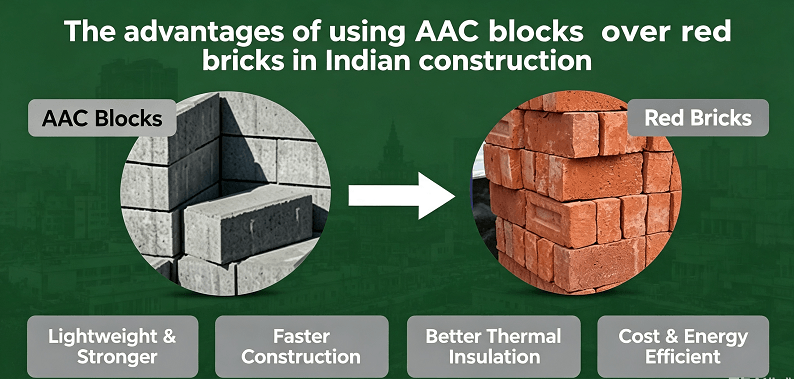
When you pick materials for your building, you want to see the real differences between aac blocks and red bricks. Your choice changes how strong your project is, how fast you build, how much you spend, and how well it lasts. You should not just look at the price of one block or brick. You need to compare the whole wall, including labor, mortar, and how it affects your building’s strength.
Key Differences Table
The table below shows the main differences between aac blocks and red bricks. You can see how each material works in important ways.
Feature | AAC Blocks | Red Bricks |
|---|---|---|
Material Composition | Silica sand or fly ash, cement, lime, aluminum paste | Clay, sand, lime, iron oxide |
Size | 600/625mm (L) x 100-300mm (H) x 230/240mm (W) | 225mm (L) x 115mm (W) x 75/70mm (H) |
Weight | 500-650 kg/m³ (about 1/3rd the weight of red bricks) | 1400-1900 kg/m³ |
Thermal Insulation | Excellent, keeps interiors cooler or warmer, reduces energy costs | Moderate, often needs extra insulation |
Fire Resistance | Excellent, high fire rating | Good |
Eco-friendliness | Sustainable, uses fly ash, less energy in production | High energy use in kilns, uses topsoil |
Labor and Handling | Lightweight, easy to transport and lay, faster construction | Heavy, slower to handle, more labor needed |
Mortar Usage | Thin-bed joint (2-3mm), uses less mortar | Thick joint (12-15mm), uses more mortar |
Plaster Requirement | Thin plaster coat due to uniform size | Thicker plaster needed to cover uneven surface |
Cost per Piece | Rs 45 to 110 | Rs 4 to 7 |
Coverage per Piece | One block covers area of 8-12 bricks | One brick covers small area |
Tip: When you compare aac block vs red brick, do not only look at the price per piece. One aac block covers the same space as 8 to 12 red bricks. You need fewer blocks, less mortar, and less labor. The wall is lighter, so your building’s frame and foundation carry less weight.
You will see that aac blocks have many benefits. The blocks are bigger and lighter than red bricks. You can move and place them faster. You use less mortar because the joints are thinner. The blocks have a smooth finish, so you need less plaster. You also get better thermal insulation, which keeps your building comfortable and lowers your energy bills.
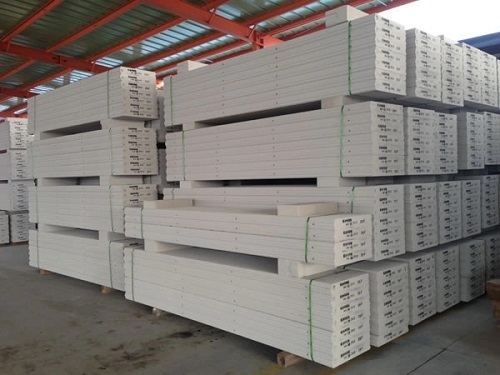
Red bricks have been used for a long time. They are strong and last many years. Builders trust them because they have used them for ages. But red bricks are heavy and need more workers. You need more mortar and plaster to finish the wall. Making red bricks uses a lot of energy and topsoil, which is bad for the environment.
When you compare aac blocks and red bricks, you see that aac blocks help you save time and money over time. You get a wall that is lighter, better insulated, and more eco-friendly. You also lower the load on your building, which can cut the cost of the structure.
If you want to build faster, save on labor, and make a modern, energy-saving building, aac blocks are the better choice. You get a finished wall that costs less when you count all the materials and work. You also help protect the environment by using sustainable materials.
Strength and Durability
Compressive Strength
When you pick building materials, you want strong walls. Compressive strength shows how much weight a material can hold. Both aac blocks and red bricks meet the needs for most buildings in India. Their strength numbers are not the same.
Material | Compressive Strength (N/mm²) |
|---|---|
AAC Blocks | 3 to 7 |
Red Bricks | 3.5 to 10 |
Red bricks can be stronger, but aac blocks are steady and reliable. For homes and offices, aac blocks are strong enough for many walls. They are lighter, so your building is not as heavy. This helps your building last longer.
Property | AAC Blocks | Red Clay Bricks |
|---|---|---|
Compressive Strength | 3-4.5 N/mm² | 2.5-3.5 N/mm² |
Density | 450-650 Kg/m³ | 1600-1900 Kg/m³ |
Wall Dead Load | Lower | Higher |
Note: Using aac blocks means your walls weigh less. This puts less stress on the foundation and frame. Your building can stay strong for more years.
Lifespan and Weather Resistance
You want your building to last a long time. Both aac blocks and red bricks can last many years. They act differently in tough weather.
Material | Average Lifespan (Years) | Durability Features |
|---|---|---|
AAC Blocks | 70–100 | Highly durable, resistant to warping, cracking, and termites |
Red Bricks | Centuries | Proven track record for long-lasting structures |
AAC blocks do not warp, crack, or get eaten by termites. This makes them good for new buildings. Red bricks have lasted for hundreds of years in old buildings.
During rainy seasons, water absorption matters:
aac blocks take in less than 15% water.
red bricks take in 15-25% water.
Waterproofing with primer and two coats of paint helps aac blocks resist rain.
AAC blocks keep your walls dry and strong in heavy rain. You get better protection from water damage. Your building stays safe and solid for a long time.
Advantages of AAC Blocks
Lightweight and Easy Handling
You want your building process to be smooth and efficient. The lightweight property of aac blocks gives you a clear advantage over red bricks. When you compare the two, you see a big difference in weight.
Material | Weight (kg/m³) | Weight per block (approx.) | Weight per square metre (kg/m²) |
|---|---|---|---|
AAC Blocks | 550–650 | 13 | 110 |
Red Bricks | 1,800–2,000 | 50 (for 14 bricks) | 350–400 |
You can see that aac blocks are almost three times lighter than red bricks. This lightweight nature means you can move, lift, and place each block with less effort. Your workers will feel less fatigue, and you can reduce the risk of injury on site. You also spend less on transportation because trucks can carry more blocks in one trip.
The lightweight quality of aac blocks reduces the dead load on your building.
You can save up to 15% on foundation and structural costs.
You need fewer workers to handle and lay the blocks.
You finish the job faster and with less physical strain.
Tip: When you use aac blocks, you do not just save on labor. You also cut costs on steel and concrete for your building’s frame because the walls weigh less.
Faster Construction
You want to finish your project on time or even ahead of schedule. The lightweight and large size of aac blocks help you build faster than with red bricks. Each block covers the area of 8 to 12 red bricks. This means you need fewer blocks to build the same wall.
A mason can lay 20 to 25 square meters of aac blocks in a day.
With red bricks, the same mason can only lay 12 to 15 square meters.
The smooth finish of aac blocks means you use less plaster and mortar.
The uniform size and shape of aac blocks make your walls straight and even. You do not need to fix uneven surfaces, which saves you time and materials. The thin-bed mortar joint (2–3 mm) uses much less mortar than the thick joints (12–15 mm) needed for red bricks.
You can see the impact on construction speed in real projects:
Project | Completion Time Reduction |
|---|---|
General Home Construction | 20% faster |
STT DC-04 | Up to 16x faster with AAC panels |
General Wall Construction | 30–50% faster |
You get your building ready sooner, which means you can move in or start using it earlier. This speed gives you a real edge, especially in large or time-sensitive projects.
Seismic Resistance
You want your building to stay safe during earthquakes. The lightweight nature of aac blocks helps your structure resist seismic forces better than red bricks. When your walls weigh less, the earthquake forces acting on your building decrease. This reduces the risk of cracks and structural damage.
AAC blocks have a cellular structure that absorbs shocks and vibrations. You get extra protection for your building, especially in earthquake-prone areas. The reduced dead load also means your foundation and frame do not face as much stress during a quake.
Note: Many engineers in India now choose aac blocks for schools, hospitals, and high-rise apartments in seismic zones. You can trust this material to keep your building strong and safe.
You see the advantages of aac blocks in every stage of construction. You get lightweight handling, faster speed, and better safety. These benefits make aac blocks the smart choice for modern construction. When you look at the finished wall, not just the price per block, you see real savings and long-term value.
AAC Block Insulation Benefits
Thermal Insulation
You want your building to feel good in every season. AAC blocks keep rooms cool in summer and warm in winter. This is because the material does not let heat move through it easily. Look at the table below to see the difference:
Material | Thermal Conductivity (W/mK) | Insulation Quality |
|---|---|---|
AAC Block | 0.11 - 0.15 | Excellent thermal insulation |
Red Brick | 0.50 - 0.70 | Poor insulation |
AAC blocks stop heat from moving much better than red bricks. The wall blocks heat three to five times more than red brick walls. This means your air conditioner or heater does not work as hard. You can save up to 30% on your energy bills. Your rooms stay the same temperature, even if the weather outside changes fast.
AAC blocks keep inside temperatures steady.
They can cut energy use for heating and cooling by up to 30%.
AAC walls block heat three to five times better than brick walls.
Less heat gets through AAC walls, so you control the temperature better.
These benefits work for all buildings, like homes and offices. AAC blocks help you make buildings that use less energy and feel comfortable all year.
Sound Insulation
Noise is a big problem in many Indian cities. You want your building to be quiet inside. AAC blocks help by blocking sound very well. The small holes in AAC blocks soak up sound waves and stop noise from coming in.
A 200 mm AAC block wall has a sound rating of 40–45 dB.
A 230 mm red brick wall has a sound rating of 45–50 dB.
Red brick walls block sound a little better, but AAC blocks still work well for most homes and offices. You will hear less noise from cars, neighbors, or busy streets. This makes AAC blocks a good choice for city buildings.
AAC blocks block sound very well.
Their tiny holes soak up sound and stop noise from outside.
This helps people who live near busy roads or in noisy places.
You can count on AAC blocks to give both good thermal and sound insulation. These features make buildings more comfortable and nicer to live or work in.
Water Absorption and Fire Safety
Moisture Resistance
You want your building to stay strong and dry, even during heavy rains or in humid climates. AAC blocks offer impressive moisture resistance, which helps protect your walls from water damage. When you compare water absorption rates, you see clear differences:
AAC blocks can absorb 30-35% water by mass, but in practical construction, their absorption rate stays between 10-15%.
Red bricks usually absorb 12-20% water, based on Indian standards.
AAC blocks perform well in humid conditions. Their structure resists environmental effects like moisture, which prevents cracking and warping. You do not need to worry about mold or pests damaging your walls. This durability means you spend less on repairs and maintenance over the years. AAC blocks can last 50–75 years with proper care. They do not break down from moisture, pests, or fire. You get a building that stands the test of time.
Tip: Choose AAC blocks for projects in coastal or rainy regions. Their moisture resistance will help you avoid common problems like damp walls and peeling paint.
Fire Resistance
You need to keep your building safe from fire hazards. Both AAC blocks and red bricks are non-combustible, which means they do not catch fire. AAC blocks can handle temperatures up to 1200°C without losing strength. Red bricks also stay strong at high heat. Each material offers a fire resistance rating of at least 4 hours, depending on wall thickness. This meets strict safety standards for construction in India.
Fire-resistant AAC blocks give you extra peace of mind. They can withstand temperatures up to 1600°C. They do not release toxic fumes during a fire. These features help you meet the National Building Code requirements for commercial and high-rise buildings. You can trust fire-resistant AAC blocks to protect lives and property.
Fire-resistant AAC blocks endure extreme heat.
They do not emit harmful gases during a fire.
Their resistance makes them ideal for schools, hospitals, and offices.
You get reliable fire safety when you use fire-resistant AAC blocks in your construction projects.
AAC and Sustainability
Eco-Friendly Materials
You want to pick materials that help the planet. AAC blocks are special because they use resources that can be reused. Factories often use recycled things like fly ash, which would be thrown away. This means fewer new materials are needed and the earth stays cleaner.
AAC blocks are made with recycled things like fly ash.
Using recycled stuff makes AAC blocks better for the environment.
This way of making blocks shows AAC blocks are good for the planet.
When you choose AAC blocks, you help cut down on trash in landfills. Making AAC blocks uses less energy than making red bricks. You help the earth by picking a material that does not hurt nature or use up resources. People who care about the planet and want to build in a green way often pick AAC blocks.
Environmental Impact
Making AAC blocks uses cleaner ways and makes less waste than making red bricks. You do not cause as much pollution as brick kilns, which burn coal and plants. These kilns hurt the earth and send bad stuff into the air. The brick industry in India causes big problems, especially in the Indo-Gangetic Plain. It uses lots of topsoil and makes air dirty.
AAC blocks make less pollution. They last long and need little fixing, so they are good for the future. You protect farmland and help keep the air clean when you use AAC blocks instead of red bricks. AAC blocks do not make high emissions like PM2.5 and black carbon, so they are a cleaner choice.
When you pick AAC blocks, you help build in a way that is good for the planet. You make things better by choosing a material that cares about the earth and being green at every step.
AAC Block Cost and Savings
Material and Transport Costs
You want to know the real cost of building with AAC blocks compared to red bricks. At first, AAC block cost per piece looks higher. Each AAC block can cost between Rs 45 and Rs 110, while a red brick costs only Rs 4 to Rs 7. But you must look at the bigger picture. One AAC block covers the same area as 8 to 12 red bricks. This means you need fewer blocks for the same wall.
Here is a table to help you compare:
Parameter | Red Clay Bricks | AAC Blocks |
|---|---|---|
Standard size | ~225 × 100 × 75 mm | Up to 600 × 200 × 200 mm |
Dry density | 1,600–1,920 kg/m³ | 550–650 kg/m³ |
Construction speed | Slower (small units) | ~30% faster |
AAC blocks are much lighter. You save on transport because trucks can carry more blocks in one trip. The lighter weight also means your building needs less steel and concrete for support. This reduces your overall cost. You finish your construction faster, which lowers labor costs. In large projects, AAC blocks cut construction time by 25–30%. You spend less on labor and equipment.
Tip: Always compare the finished wall cost, not just the price per block. This includes steel, mortar, plaster, and labor.
Mortar and Plaster Savings
AAC blocks help you save even more on mortar and plaster. You use thin-bed mortar joints, only 2–3 mm thick. Red bricks need thick mortar joints, about 12–15 mm. This means you use much less mortar with AAC blocks.
Component | Savings |
|---|---|
Mortar | 60–70% |
Plaster | 25–35% |
You also need less plaster because AAC blocks have a smooth, uniform surface. You save up to 35% on plaster. These savings add up quickly, especially in big buildings. For example, if you build a 1,000 sq ft wall, you can save thousands of rupees on mortar and plaster alone.
AAC block cost efficiency comes from all these factors. You get cost-effective construction, lower labor bills, and less waste. Over time, the long-term cost efficiency of AAC blocks makes them the smart choice for builders and homeowners. You see real savings in every part of your project.
AAC in Modern Construction
Size and Uniformity
You want your building project to run smoothly. The size and uniformity of aac blocks help you achieve this goal. Each block comes in a standard, large size. You can cover more wall area with fewer blocks. This means you need to handle, transport, and lay fewer units during construction. You save time and reduce labor costs.
AAC blocks have precise dimensions. You get straight walls and sharp corners without extra effort. The uniformity allows you to use thin-bed mortar joints, which are only 2 to 3 mm thick. You use less mortar and get a cleaner finish. When you compare this to traditional bricks, you see that bricks often vary in size. You spend more time adjusting and filling gaps. The result is a wall that may not look as neat or strong.
Tip: Uniform blocks make it easier to plan and execute your construction. You avoid surprises and keep your project on schedule.
Quality and Finish
You expect a high-quality finish in modern construction. AAC blocks deliver this with their smooth surfaces and consistent shape. You need less plaster to achieve a perfect wall. The even surface reduces the amount of finishing work required. You save on both materials and labor.
AAC blocks resist cracks and shrinkage. Your walls stay strong and look good for years. The blocks do not warp or change shape over time. You get a durable structure that meets modern standards. Builders and homeowners appreciate the professional look that aac blocks provide.
Smooth finish reduces plaster thickness
Consistent quality means fewer repairs
Modern appearance suits all types of buildings
AAC blocks help you build faster, better, and with fewer problems. You get a finished wall that stands out for its quality and appearance.
When to Choose AAC Blocks
Ideal Building Types
You should pick aac blocks if you want a modern and green building. These blocks are best when you need to build fast and keep the building cool or warm. They also help when you want your building to be lighter. You get the most from aac blocks in these places:
Homes, apartments, and villas stay cooler and get built faster.
Offices, malls, and hotels save energy and finish on time.
Factories and warehouses need strong, light walls that do not burn or get wet.
You can use aac blocks for schools, hospitals, and tall buildings too. These places need to be safe, comfy, and last a long time. In places with earthquakes, the lighter weight of aac blocks helps keep buildings safe by lowering the shaking force.
Tip: If you want your project done fast, want to pay less for energy, or need to follow green rules, aac blocks are a smart pick.
Real-World Scenarios
There are many times when people use aac blocks in India. In Mumbai, builders use them for tall apartments. This makes the building lighter and helps finish work faster. In Chennai, hospitals use aac blocks because they do not catch fire and block noise. This keeps patients safe and rooms quiet. In Delhi, big office buildings use aac blocks to save on air conditioning and follow energy rules.
You can also see aac blocks in schools in earthquake areas like Gujarat. The light walls help protect kids and teachers if there is an earthquake. Many factories in India use aac blocks to build big storage buildings quickly and easily.
You should use aac blocks if you want your building to be safe, comfy, and save money. These blocks help you build in a smart way and give you good results for many years.
You get lots of benefits when you pick aac blocks for your building.
You spend less money on the structure because aac blocks weigh less and need less steel and concrete.
Your building is finished sooner since workers can lay aac blocks faster than red bricks.
Your rooms stay cooler and you use less energy because aac blocks keep heat out better.
You make less waste and help the planet by using materials that fit today’s standards.
To get the best outcome, ask an expert to see if aac blocks are right for your project.
FAQ
How do AAC blocks compare to red bricks in cost?
You see a higher price per AAC block, but each block covers more area. You use fewer blocks, less mortar, and less labor. When you count the finished wall, AAC blocks often cost less than red bricks.
Are AAC blocks strong enough for Indian homes?
AAC blocks meet Indian standards for strength. You can use them for homes, offices, and tall buildings. Their lighter weight reduces stress on your structure, making your building safer and more durable.
Do AAC blocks help save labor and time?
You lay AAC blocks faster because they are larger and lighter. A mason covers more wall area each day. You finish your project sooner and spend less on labor.
Will AAC blocks reduce mortar and plaster costs?
AAC blocks need thin-bed mortar joints and a thinner plaster coat. You use much less mortar and plaster compared to red bricks. This saves you money and gives your walls a smooth finish.
Are AAC blocks good for earthquake-prone areas?
AAC blocks weigh less than red bricks. You lower the dead load on your building. This helps your structure resist earthquake forces and keeps your building safer.


