


AAC Blocks Factory Guide 2026: Types, Prices, Advantages, and Applications
If you are planning to enter the AAC block manufacturing business or simply want to understand what an AAC blocks factory looks like in 2026, this guide is for you. Autoclaved Aerated Concrete (AAC) has become one of the fastest-growing building materials globally, driven by the need for lightweight, energy-efficient, and sustainable construction solutions. Whether you are an investor scouting for an
aac blocks manufacturing plant or a builder evaluating materials, understanding the types, costs, benefits, and uses of AAC blocks will help you make informed decisions.
Key Takeaways
| Topic | Key Insight |
|---|---|
| Global Market Size (2026) | $24.2 billion, growing at 7.4% CAGR |
| Typical AAC Block Price | $40–$90 per cubic meter (FOB) |
| Main Types | Fire-resistant, 200mm (load-bearing), 100mm (partitions), long-lasting, fly ash-based |
| Key Advantages | Lightweight, thermal insulation, fire resistance, soundproofing, eco-friendly |
| Primary Applications | Residential, commercial, industrial walls, partitions, fire zones, green buildings |
| Factory Investment Factors | Capacity, automation level, raw material type, location |
1. What Is an AAC Blocks Factory?
An AAC blocks factory is a manufacturing facility that produces Autoclaved Aerated Concrete blocks using a carefully controlled process. The raw materials—cement, lime, fly ash, water, and a small amount of aluminum powder—are mixed, poured into molds, and then cured in an autoclave under high pressure and temperature. This process creates a lightweight, cellular concrete block with excellent thermal and acoustic insulation properties.
A modern aac blocks manufacturing plant is a highly automated system that transforms these raw materials into finished blocks ready for construction. The production line typically includes raw material processing, batching and mixing, pouring, pre-curing, cutting, autoclaving, and packaging sections.
Why Invest in an AAC Blocks Factory?
Growing demand: The global AAC blocks and panels market is projected to grow from $22.54 billion in 2025 to $24.2 billion in 2026, at a CAGR of 7.4%.
Government support: Many countries promote AAC as a green building material, offering incentives for sustainable construction.
Superior product: AAC blocks are lighter, stronger, more insulating, and more fire-resistant than traditional clay bricks.
2. Types of AAC Blocks
Not all AAC blocks are the same. An aac blocks machine can produce different types depending on the raw material mix and production parameters. Here are the main types available in 2026:
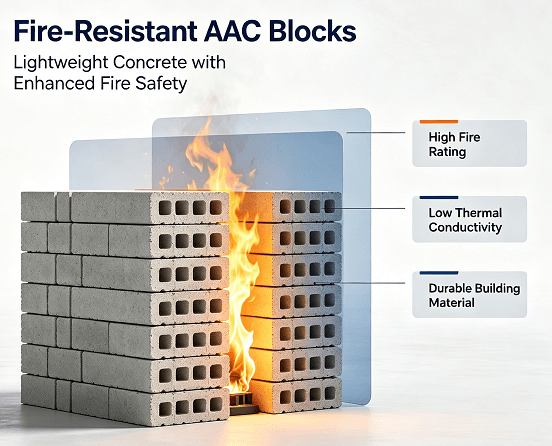
2.1 Fire-Resistant AAC Blocks
These blocks are specially formulated to withstand high temperatures. They are ideal for kitchens, electrical rooms, firewalls, and any area where fire safety is a priority.
2.2 200 mm AAC Blocks (Standard Load-Bearing)
This is the most common size for exterior walls and load-bearing structures. The 200 mm thickness provides excellent strength and thermal regulation, making it suitable for multi-story buildings.
2.3 100 mm AAC Blocks (Internal Partitions)
Thinner and lighter, these blocks are perfect for internal partitions and non-load-bearing walls. They save space, are easy to install, and reduce the overall weight of the structure.
2.4 Long-Lasting AAC Blocks
Designed for extreme durability, these blocks resist cracking and weathering over decades. They are ideal for regions with harsh climate conditions.
2.5 Rectangular Fly Ash AAC Blocks
Made from fly ash, these blocks are eco-friendly and contribute to waste reduction. They are a sustainable choice for green building projects.
3. AAC Block Prices in 2026
One of the most common questions about an AAC blocks factory is: How much do AAC blocks cost?
In 2026, AAC block prices typically range from $40 to $90 per cubic meter (FOB) for standard products. However, the final price depends on several factors:
| Factor | Impact on Price |
|---|---|
| Production capacity | Higher capacity plants achieve economies of scale, lowering unit costs |
| Automation level | Fully automated lines cost more upfront but reduce long-term production costs |
| Raw material type | Sand-based vs. fly ash-based AAC blocks have different cost structures |
| Location | Land, labor, and utility costs vary by region |
| Thickness and size | 200 mm blocks cost more than 100 mm blocks |
For a medium-scale aac blocks manufacturing plant, the total investment typically ranges from $500,000 to $2 million, depending on capacity and automation. While AAC blocks may cost more upfront than traditional red bricks, they offer better return on investment (ROI) through faster construction, reduced labor costs, savings in steel and concrete usage, and long-term energy savings.
4. Advantages of AAC Blocks
Why are builders and investors increasingly choosing AAC blocks over traditional materials? Here are the key advantages:
4.1 Lightweight Construction Material
AAC blocks weigh only about one-third of traditional clay bricks. This reduces the structural load on buildings, lowers transportation costs, and makes handling and installation faster and easier.
4.2 Excellent Thermal Insulation
The closed-cell structure of AAC provides superior thermal insulation. Buildings constructed with AAC blocks require less heating and cooling, reducing energy consumption by up to 30%.
4.3 Superior Fire Resistance
AAC blocks are fire-resistant and can withstand high temperatures without releasing toxic gases. They are commonly used in firewalls and service shafts.
4.4 Sound Insulation
The porous structure of AAC effectively absorbs sound, making it ideal for homes, hospitals, schools, and offices where noise reduction is important.
4.5 Eco-Friendly and Sustainable
AAC blocks are made from fly ash and other industrial by-products, reducing waste and environmental impact. They are a certified green building material.
4.6 Faster Construction
The lightweight nature and precise dimensions of AAC blocks allow for faster construction—typically 30–40% faster than traditional bricks.
4.7 Disaster Resistance
AAC blocks are durable, moisture-resistant, and can withstand extreme weather conditions, making them suitable for disaster-prone areas.
5. Applications of AAC Blocks
AAC blocks are versatile and can be used in a wide range of construction projects:
5.1 Residential Construction
Exterior and interior walls
Load-bearing walls (200 mm blocks)
Internal partitions (100 mm blocks)
Flooring and roofing systems
5.2 Commercial Construction
Office buildings and retail spaces
Hospitals and hotels
Schools and educational facilities
Firewalls and service shafts
5.3 Industrial Construction
Factories and warehouses
Sound barriers and acoustic walls
Fire-resistant zones
5.4 Green Building Projects
AAC blocks are widely used in LEED-certified and other green building projects due to their sustainability and energy efficiency.
6. Setting Up an AAC Blocks Factory
If you are considering investing in an AAC blocks factory, here is what you need to know:
6.1 Key Investment Factors
Production capacity: Define your target daily or annual output
Automation level: Choose between semi-automatic and fully automatic lines
Raw material availability: Ensure reliable supply of cement, lime, fly ash, and aluminum powder
Location: Consider proximity to raw materials, labor, and target markets
6.2 Teeyer's Role in AAC Factory Setup
Teeyer Intelligent Equipment Co., Ltd. has over 35 years of experience in the AAC industry, with more than 1,200 production lines delivered globally. Teeyer provides complete turnkey solutions for aac blocks manufacturing plant projects, including:
Plant planning and process design
Equipment manufacturing and supply
Installation and commissioning
Operator training and after-sales support
6.3 Proven Global Track Record
Teeyer's expertise is demonstrated by landmark projects worldwide:
Indonesia Fuxin Project: The highest-capacity AAC block production line in Indonesia, with a monthly output of 80,000 cubic meters.
India Plant Upgrade: Teeyer upgraded an existing line from 900 to 1,500 m³ per day in just two months.
China Mega-Project: Teeyer supported Xinfa Group in building 16 AAC production lines across four major bases.
When you choose Teeyer as your partner, you get more than just an aac blocks machine—you get a partner who understands local market conditions, provides cutting-edge technology, and ensures your factory operates at peak efficiency.
7. Advantages of Partnering with Teeyer
| Advantage | What It Means for You |
|---|---|
| 35+ Years of Experience | Proven expertise in AAC technology and project execution |
| 1,200+ Lines Delivered | Global track record across 30+ countries |
| Turnkey Solutions | Single-supplier accountability from design to commissioning |
| Advanced Technology | Siemens PLC-based automation, servo-driven cutting, energy-efficient systems |
| Comprehensive Support | Training, spare parts, remote diagnostics, and after-sales service |
FAQ
Ready to Build Your AAC Blocks Factory?
The AAC block market is growing rapidly, with global demand projected to reach $24.2 billion in 2026. Whether you are planning a new aac blocks manufacturing plant or upgrading an existing line, choosing the right partner is critical to your success.
Contact Teeyer today to discuss your AAC blocks factory project. With over 35 years of experience, 1,200+ lines delivered globally, and a commitment to customer success, Teeyer is your trusted partner for building a profitable and sustainable AAC blocks business.
Resource:Research and Markets《AAC Blocks and Panels Market Report 2026》、GlobeNewswire


