


AAC vs. Red Bricks in Egypt: A Complete Cost & Performance Analysis for 2026
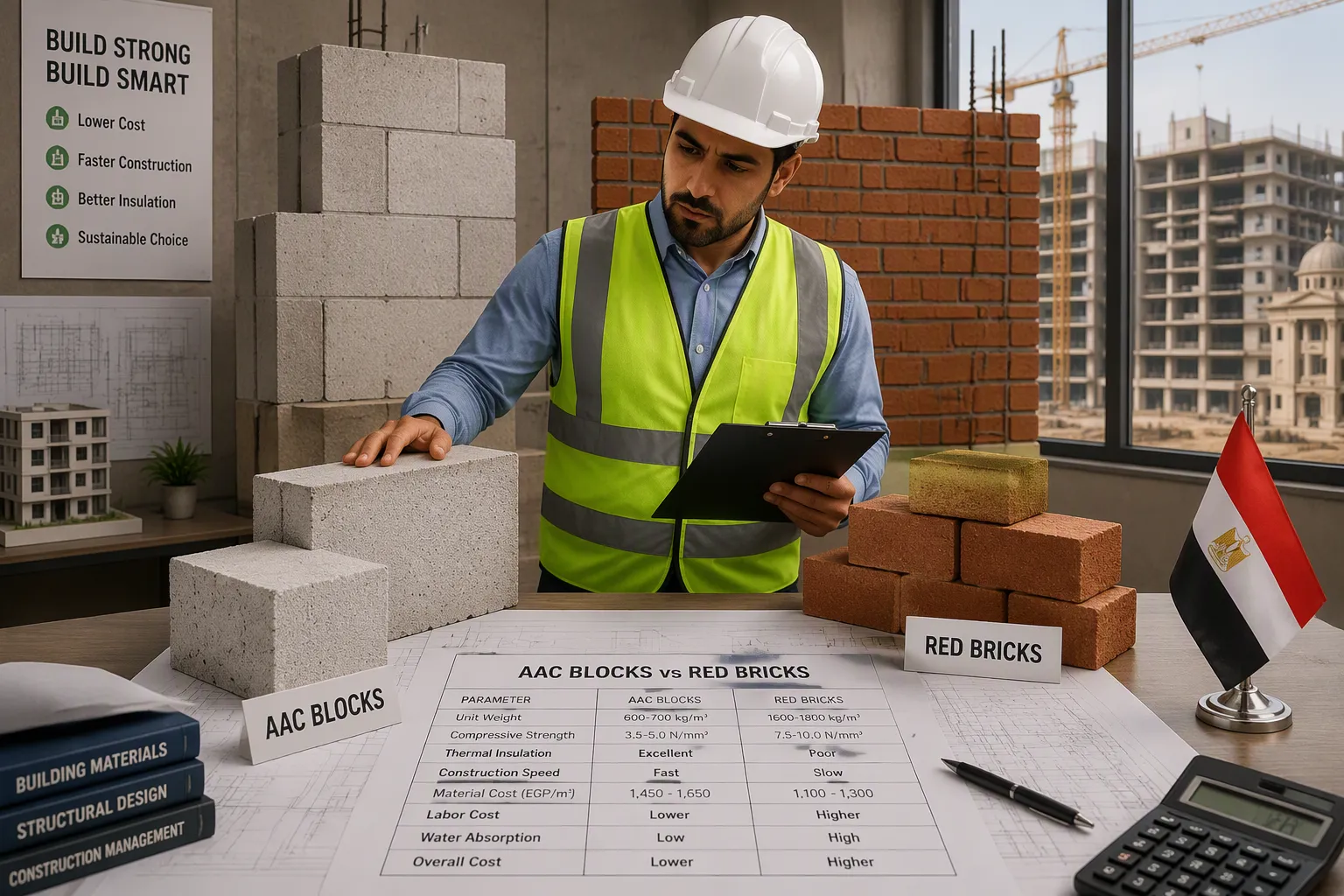
For most modern building projects in Egypt in 2026, AAC blocks give better overall value and performance. Red bricks are still a good choice for some specific uses. This analysis compares upfront price, total wall cost, thermal insulation, strength, weight, durability, code compliance, and environmental impact. Recent price changes for materials, rising energy costs, and updated building rules make this comparison timely, especially as aac production egypt grows.
Key Takeaways
Compare the total cost of the wall, not just the price of one block or brick. AAC blocks often save money on labor and plaster. This makes them a better overall value.
AAC blocks keep your home cooler and lower your power bills. They block heat 3–4 times better than red bricks.
Pick AAC blocks for modern, multi-story buildings and to save energy. Pick red bricks for traditional load-bearing walls and special architectural looks.
AAC Production in Egypt: The 2026 Cost Picture
From Per-Unit to Total Wall Cost
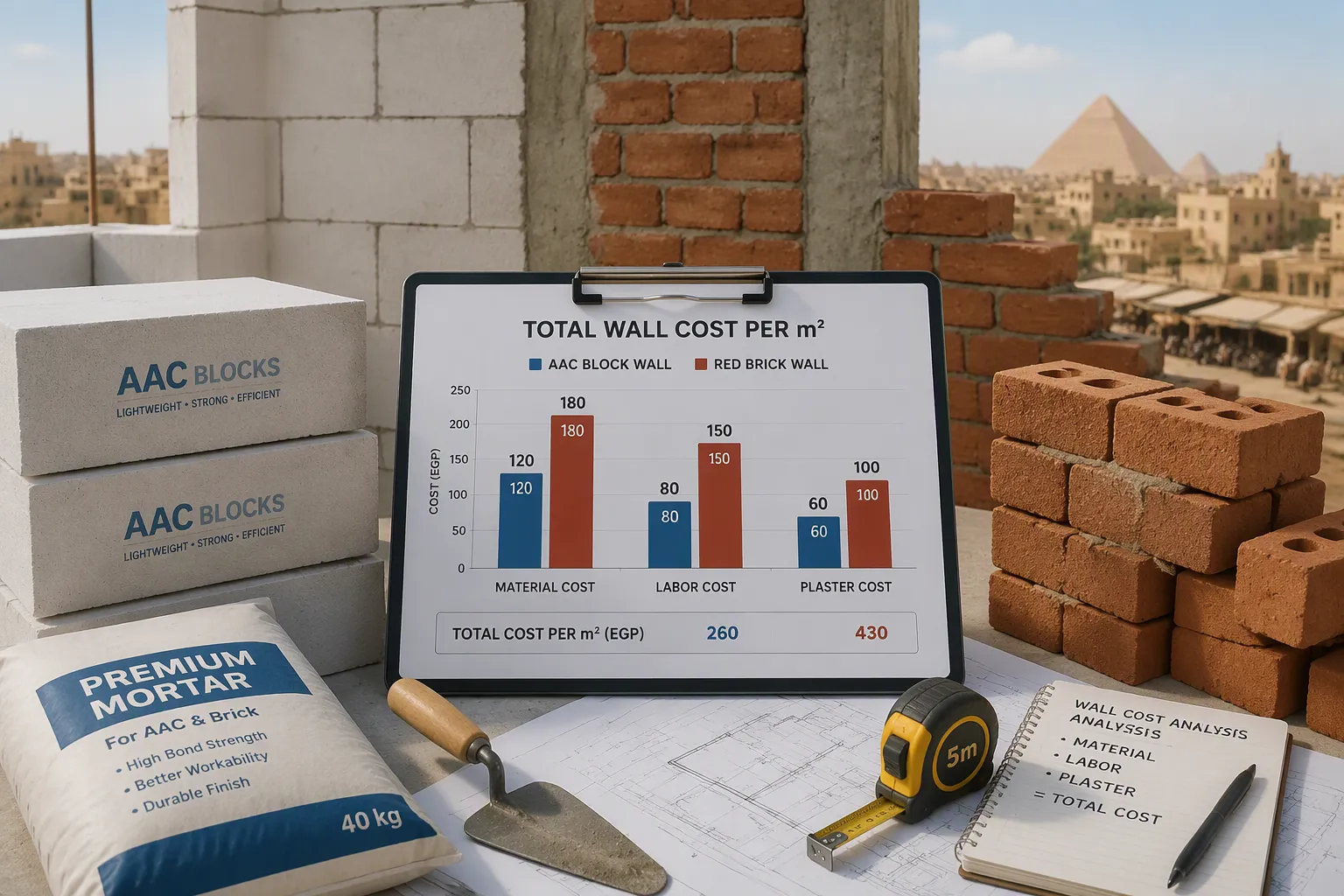
A single AAC block often carries a higher price tag than a single red brick. That comparison misleads you. One AAC block covers far more wall area than several traditional bricks. You need a fairer measure: the total wall cost. This figure combines material, labor, and plaster. Count the blocks per square meter first. Multiply that count by the unit price. Then add mortar bags, mason hours, and finishing coats. AAC blocks are large and uniform. A mason lays them quickly and uses less mortar. Plaster goes on thinner over a flat AAC face. Red bricks need more joints, more mortar, and more skilled laying time. The per-unit price hides these differences. The total wall cost reveals them.
Market trends in 2026 add weight to this view. Red clay bricks have become roughly 20% more expensive than their AAC counterparts. Changes in the red brick industry drive this shift. Treat it as a market trend, not a flaw in red bricks. Energy-intensive clay firing and shifting supply patterns push red brick prices upward. AAC production in Egypt has expanded in parallel. Growing local output keeps block prices stable.
AAC Production Egypt: Cost per Square Meter
Pricing in Egypt varies by region, supplier, and order volume. General market ranges matter more than exact figures. Expect AAC block prices to sit below red brick prices on a per-square-meter basis in most Egyptian markets in 2026. Labor savings widen that gap. A crew finishes an AAC wall faster, so you pay fewer labor hours per square meter. Plaster consumption drops too. Thinner coats mean less cement and sand.
Your total cost per square meter therefore includes three parts: block or brick cost, laying labor, and plaster materials. AAC wins on all three in most modern projects. Rising aac production egypt capacity supports this trend. More local plants mean shorter delivery distances and steadier supply. You should still request quotes from several suppliers. Prices move with cement costs, fuel, and transport. Compare full wall assemblies, never single units. That habit protects your budget and your schedule.
Thermal Performance and Energy Savings
How AAC Blocks Cut Cooling Loads
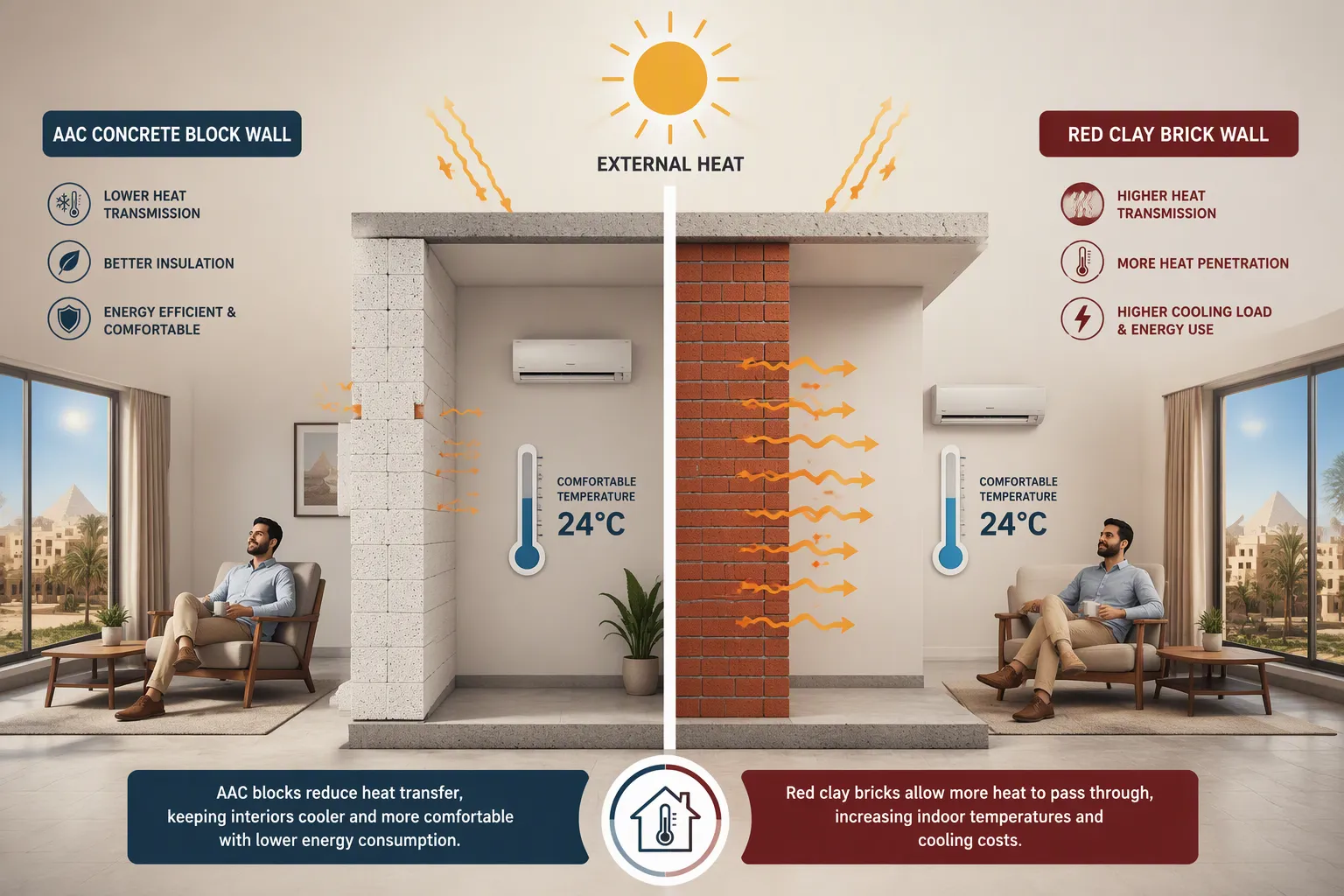
Egyptian summers are hard on a wall that is not well insulated. Heat moves through the wall, so your air conditioner has to work harder to keep the temperature you set. AAC blocks slow down that heat transfer. Their low density and porous, air-filled structure block heat flow much better than fired clay. Air trapped in millions of tiny pores does the insulating work. Clay fires into a dense, solid mass with much less trapped air. The numbers show the gap clearly. AAC blocks have a thermal conductivity of 0.16 W/m·K. Red bricks sit at 0.6–0.8 W/m·K. So an AAC wall moves about 3–4 times less heat than a red brick wall of similar thickness. Less heat transfer means a smaller cooling load, shorter compressor run times, and steadier indoor temperatures through July and August. You can also reach a target resistance with a thinner AAC wall, which saves usable floor area. A red brick wall must get thicker to match that resistance, and thickness costs money in material and labor. You feel the difference in comfort first and in the electricity bill later.
Red Bricks and Heat in Egyptian Climates
Red bricks deserve a fair look here. Their higher density gives them more thermal mass. A dense brick wall takes in heat slowly and gives it off slowly. This behavior fits certain wall assemblies and finish strategies, especially where you want evening heat release or a solid, traditional wall build-up. The trade-off is real, though. More heat held during the day leaves more heat to manage at night. Modern finishes can change that result. A reflective coating or a rainscreen detail cuts the solar gain a brick wall absorbs. Pair red brick walls with insulation or a ventilated finish when cooling performance matters to you. Density alone does not decide comfort; the full wall build-up does.
Insulation performance belongs in your total cost picture, not in a separate column. A wall that resists heat lowers your monthly electricity spend for the life of the building. Those savings add up year after year and often outweigh a small difference in upfront material price. Factor in rising tariffs and longer cooling seasons, and the case gets stronger. Treat thermal performance as a line item in your wall budget, right beside blocks, mortar, and labor. The cheapest wall on day one is rarely the cheapest wall over twenty years. Ask your supplier for thermal data on the specific block density you plan to buy. Local aac production egypt capacity now gives you more density options than before, so you can match the wall to your budget and your climate goals.
Strength, Weight, and Durability
Load-Bearing Capacity Compared
Red bricks carry a long record of traditional strength and durability. Fired clay resists impact well and holds up under heavy loads. AAC blocks take a different path. Their composition of fly ash, cement, lime, and gypsum, cured under steam pressure, produces a solid but porous block. Compressive strength stays adequate for most wall applications, including infill walls in framed buildings. You should match the block grade to the structural role. Use AAC for non-load-bearing and infill walls, and keep red brick where a wall must carry loads directly.
Dead Load and Construction Speed
Weight changes the math for your whole structure. AAC blocks cut wall weight by about 65% compared with red bricks. AAC wall panels also run 3–4 times lighter than traditional red clay bricks. That lighter wall reduces the load on your foundation and frame. You save on foundation construction cost, and the benefit grows on high-rise projects or sites with poor soil. Red bricks remain reliable for traditional load-bearing walls, where their mass works in your favor.
Speed follows weight. A mason lays AAC blocks far faster than red bricks, and one AAC block covers the area of 8–12 bricks.
Material | Daily installation speed (per mason) |
|---|---|
AAC blocks | 20–25 m²/day |
Red bricks | 12–15 m²/day |
Faster walls mean fewer labor hours and shorter schedules. Growing aac production egypt capacity keeps supply steady as more projects make the switch.
Code Compliance and Environmental Impact
Egyptian Building Requirements in 2026
Egypt's building rules now push you toward walls that perform better. A side-by-side study of red brick and AAC wall systems for Egyptian construction, including a case study in the new Egyptian administrative capital, shows how each material meets these rules. Two documents control thermal performance:
Standard / Code | Issuing Body / Year | Scope |
|---|---|---|
HBRC Specifications for Thermal Insulation Works | HBRC, Egypt, 2007 | Thermal performance criteria for building envelope elements |
RBEE Code | Egypt | Mandatory thermal resistance requirements for opaque envelope components |
You must add insulation when a part of the wall falls below the RBEE limit. AAC's lower thermal conductivity helps you pass these limits with a thinner wall. Red brick walls often need extra insulation to comply. Keep the thermal data sheet for the block density you pick on file. Inspectors may ask for it during approval. Check the current code edition with your local authority before you finalize your wall design.
Embodied Energy and Sustainability
The energy used to make a material matters as much as the energy used to run the building.
Bricks have a higher embodied energy compared to AAC blocks, meaning more energy is required for their production.
A 2024 study of affordable housing in Delhi (Jain et al., 2024) puts AAC at 3.7 MJ/kg and burnt clay brick at 6.5 MJ/kg. The choice of raw material makes the gap wider. Clay-fired red bricks use freshly dug soil, about 18 tonnes per lakh bricks, and burn 12–14 tonnes of coal per lakh bricks. AAC blocks use fly ash, a waste byproduct from thermal power generation, so virgin topsoil use is negligible. Fly ash also takes the place of clay in the mix, which lowers coal demand. Growing aac production egypt capacity lets you source blocks with this lower-impact profile locally. Ask your supplier for the mix design and embodied energy figures. Match your material choice to both the code and your sustainability goals.
Teeyer AAC Solutions: Building the Supply Side
From Feasibility to Smart Operation
Egypt's growing aac production egypt capacity depends on plants that work well from the first day. Jiangsu Teeyer Intelligent Equipment Co., Ltd. has helped build these kinds of plants for over 35 years. The company has delivered more than 1,000 AAC production lines around the world. It also holds ISO 9001 certification and was listed on the Main Board in 2023.
Teeyer AAC Solutions covers the whole life of a plant. You begin with pre-investment analysis, feasibility studies, and ROI analysis. Then come customized plant design and EPC project management. After production starts, the MES smart operation system connects orders to production plans. It also automates scheduling and mold allocation, watches equipment in real time, and spots energy waste before it grows. Teeyer Academy trains your operators, and a global spare parts network keeps lines running.
ROI Driver | How It Improves Return |
|---|---|
Production efficiency | Automated systems and improved processes cut labor and energy costs |
Energy savings | Waste-heat recovery and steam efficiency lower operating expenses |
Material savings | High-precision cutting reduces waste; recycled materials lower raw-material costs |
Faster installation | Shorter timelines improve project cash flow |
Global Delivery, Local Relevance
Teeyer has shipped lines to more than 20 countries and regions. Each project shows how supply capacity takes shape. NCC Bahrain built the largest AAC line in the GCC region under an EPC contract. Uzbekistan Megaton used Teeyer's intelligent cutting system. Thailand Diamond used green separation technology and raised production efficiency by over 50%. The Russian INFRA project will add 450,000 m³ per year in Bashkortostan.
These projects matter to Egyptian buyers. A mature supplier base shortens the path from investment decision to a working plant. That supply depth supports aac production egypt growth and gives you more reliable local sourcing options.
Which Material Fits Your Project?
Best Applications for AAC Blocks
AAC blocks work well for modern buildings with many floors. They weigh about one-third as much as red bricks, so your foundation and frame carry less. This saving often shows up in the amount of steel and concrete you need. Tall buildings gain the most, because each extra floor adds more weight. Projects that care about energy also benefit. The porous structure gives strong thermal and sound insulation, and your cooling bills go down over the building's life. Fast building schedules fit AAC too. Large, even blocks mean fewer joints, less mortar, and thinner plaster. A crew finishes a wall in less time.
The New Egyptian Administrative Capital case study supports this fit. Researchers found that AAC wall systems can offer benefits in project cost and environmental performance. The material you choose strongly affects lifecycle cost and environmental impact. Growing aac production egypt capacity now makes these blocks easier to find in city centers.
Where Red Bricks Still Make Sense
Red bricks still have a clear role in traditional load-bearing walls. Their compressive strength is about 7–10 N/mm², compared with 3–5 N/mm² for AAC. That higher raw strength works well for walls that carry heavy direct loads in ordinary designs. Many Egyptian builders still treat red brick as the default wall material, mostly because it is affordable and found almost everywhere. If your design follows a traditional load-bearing approach, red brick is still a dependable choice.
Architectural preference matters too. Some facades, textures, and details call for fired clay, and no other material gives the same look. Both materials have a place. Match the block to the structural system, the schedule, and the finish you want.
For most modern building projects in Egypt in 2026, AAC blocks give you better overall value. Red bricks still work well for traditional load-bearing walls and certain architectural looks. Think about four things: total wall cost with energy savings, thermal comfort, structural weight, and code compliance. Then pick the material that fits your project type, budget, and performance goals.
FAQ
Does a higher block price make AAC more expensive overall?
No. Compare total wall cost, not unit price. One AAC block covers far more area than several bricks. You also spend less on mortar, plaster, and mason hours.
How much better is AAC at blocking heat?
AAC blocks conduct heat at 0.16 W/m·K. Red bricks sit at 0.6–0.8 W/m·K. An AAC wall moves roughly 3–4 times less heat at similar thickness, so your cooling load drops.
Can I still use red bricks for a load-bearing wall?
Yes. Red bricks reach about 7–10 N/mm² in compressive strength, against 3–5 N/mm² for AAC. Traditional load-bearing designs remain a good fit for fired clay.
Please Contact Us!
Recommended Products


Recent News
1.How to Start an AAC Block Business: Plant Setup Guide
2026-09-282.AAC Mix Design for Different Climates: Step-by-Step Guide
2026-09-213.How to Start an AAC Block Manufacturing Plant in the Middle East for Maximum Profit
2026-09-104.How an AAC production line can produce both blocks and panels
2026-09-02


