


Ready to build your AAC plant?
Teeyer's engineering team has commissioned 1,200+ AAC production lines across 30+ countries. Share your raw material profile, target capacity, and timeline for a tailored feasibility discussion.
Request a Quote Today

AAC plant manufacturing involves specific, measurable things — factory footprint in square meters, annual output in cubic meters per year, autoclave vessel counts, pressure and temperature parameters, and a chain of quality checkpoints that starts before raw materials enter the mixer and ends with dimensional tolerances on finished blocks. Understanding these specifics is the difference between evaluating a real manufacturing operation and accepting a brochure at face value.
This article opens the doors of an AAC plant manufacturer — examining factory scale, how production capacity is calculated, what each stage of the production line looks like in practice, and where quality control actually happens. That perspective comes from an engineering team that has designed and commissioned more than 1,200 production lines across 30 countries — the same lens we use when walking investors through our own factory floor and delivered plants.
"Factory scale" is not an abstract credential. It translates directly into three physical things: the land area of the manufacturing base, the number and size of autoclaves, and the engineering and technical staff capable of designing, assembling, and supporting production lines.
A small-scale AAC plant manufacturer operates on roughly 4,000–10,000 m², running 1–3 autoclaves with an output ceiling of around 100,000 m³/year. Medium-scale operations occupy 10,000–20,000 m² with 4–8 autoclaves and annual output in the 100,000–300,000 m³ range. Large-scale manufacturers — those genuinely capable of delivering high-output EPC turnkey plants — require more than 20,000 m², 8–12 or more autoclaves, and substantial in-house engineering and R&D capacity.
These distinctions matter for one practical reason: a manufacturer whose own factory runs at small-scale rarely has the engineering depth to design, commission, and troubleshoot a large-scale plant for a client. The factory is a proxy for capability.
The other factor that rarely appears in brochures is R&D staffing. Customizing a production line for different raw material profiles — fly ash versus sand-based systems, variable lime reactivity, altitude effects on autoclave pressure — requires dedicated process engineering expertise, not just equipment assembly. For investors evaluating manufacturers, R&D headcount and patent portfolio are concrete proxies for this capability.
Production capacity in AAC is always expressed in cubic meters per year (m³/year), not block counts. The industry convention uses 300 operating days per year as the calculation baseline. A plant producing 1,000 m³/day at that baseline yields 300,000 m³/year.
The table below reflects industry-standard scale classifications, cross-referenced against autoclave equipment and factory footprint requirements:
| Scale | Annual Capacity | Daily Output | Autoclaves | Factory Footprint |
|---|---|---|---|---|
| Small | 30,000–100,000 m³/year | ~100–333 m³/day | 1–3 sets | ~4,000–10,000 m² |
| Medium | 100,000–300,000 m³/year | ~333–1,000 m³/day | 4–8 sets | ~10,000–20,000 m² |
| Large | 300,000–600,000 m³/year | ~1,000–2,000 m³/day | 8–12+ sets | >20,000 m² |
| Ultra-high | 600,000–1,000,000+ m³/year | >2,000 m³/day | Multiple parallel lines | Industrial complex scale |
These band classifications follow well-established benchmarks across the AAC equipment sector.
The 300-day operating year accounts for planned maintenance shutdowns, autoclave inspection cycles, and public holidays. When a manufacturer quotes annual capacity, that figure assumes the line runs at full designed output for 300 days. Lines that run below designed utilization — a common operational reality — produce less. The industry benchmark for a healthy plant is 85% or above capacity utilization; many plants run below 70–85%, which directly compresses profitability and extends payback timelines.
This is not a manufacturing flaw — it is a design and commissioning challenge. It makes the difference between commissioning quality and raw equipment specification one of the most commercially significant variables in plant procurement.
The AAC block manufacturing plant process is sequential. Each stage feeds into the next, and quality failures at any point compound through the chain.
Sand or fly ash, cement, lime, gypsum, aluminum powder, and water arrive at the plant in distinct storage silos. Before any batch begins, each raw material is characterized for its relevant quality parameters — more on this in the quality control section.
The dosing stage is where precision matters most. The accuracy of dosing and mixing defines the quality of final products more than any other single variable; this principle holds across every AAC process design in the market. Automated dosing systems weigh each material to exact proportions before mixing. Deviations at this stage — even small ones — translate directly into density inconsistency, strength variation, and dimensional instability in finished blocks.
Mixed slurry is poured into steel molds. Within minutes, aluminum powder reacts with calcium hydroxide in the lime, producing hydrogen gas that forms the cellular pore structure as the mass rises. The target rising height must be reached within a specific gassing time window; too fast or too slow indicates an imbalance in lime reactivity or aluminum dosing.
The mold rests in a temperature-controlled pre-curing room — typically called the fermentation or hardening area — where the green cake (the uncured cellular mass) achieves sufficient hardness to withstand wire cutting without deformation. Core and surface temperature are monitored continuously during this phase.
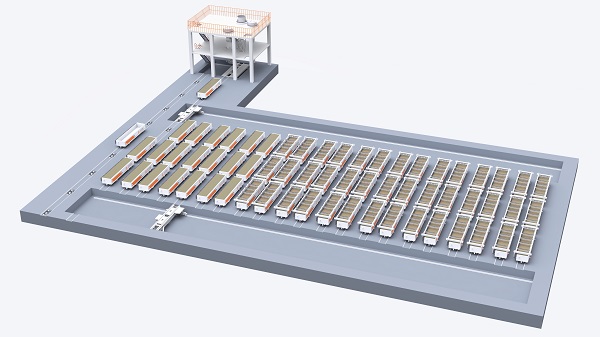
Once the green cake reaches target hardness, it is transferred to a cutting station. Horizontal and vertical wire-cutting systems slice it into blocks or panels of specified dimensions. The dimensional tolerances achievable here — typically ±1–2 mm in length, width, and height — are a direct function of cutting system precision and green cake consistency.
After cutting, the blocks enter the autoclaves for high-pressure steam curing. This is the stage that gives AAC its defining properties. Under saturated steam at 180–200°C and 1.0–1.3 MPa, silica (SiO₂) and calcium hydroxide react to form tobermorite (chemical formula: C₅S₆H₅), a crystalline calcium silicate hydrate that is the primary binding phase responsible for AAC's compressive strength and dimensional stability. Cycle times typically run 8–12 hours, though sizes and product densities can extend this to 20 hours for specific grades.
Key insight: The autoclave cycle is not simply "bake until done." The temperature hold duration directly governs tobermorite crystal formation. An under-cycled batch produces incomplete hydrothermal reactions and weaker pore structures; an over-cycled batch can cause tobermorite to break down into less beneficial phases. Controlling the cycle precisely — and verifying it per batch — is one of the clearest separators between manufacturers with real process discipline and those without.
Before any batch enters production, incoming materials go through a defined inspection protocol. Fly ash and sand are tested for fineness, loss on ignition (LOI), moisture content, and chemical composition (SiO₂, Al₂O₃, Fe₂O₃). Cement and lime are verified for compressive strength, reactivity, free lime content, and setting time. Gypsum purity (CaSO₄·2H₂O), aluminum powder fineness and reactivity, and water pH are all checked against defined acceptance limits.
Raw material variability is one of the most common sources of batch-to-batch quality inconsistency in plants that skip this stage or treat it as optional.
At the casting area, slurry density, viscosity, pH, and temperature are measured before pouring. In the rising area, gassing time, rising height, and surface condition are monitored against expected curves. Deviations trigger formula adjustments before the next batch. At the cutting station, the green hardness test and dimensional measurements confirm the block geometry before autoclave loading.
After autoclaving and cooling, finished blocks are tested against the product standard for the target market. Standard test parameters include:
Dry density: 550–650 kg/m³ depending on product grade
Compressive strength: minimum 3.8–4.2 N/mm² for standard grades; higher grades exceed 5 MPa
Water absorption: ≤10–15% by mass
Dimensional accuracy: length, width, and height within ±1–2 mm of specification
Soundness: no visible cracking after curing
Applicable standards include IS 2185 (Part 3), EN 771-4, ASTM C1693, and ISO 9001:2015 quality management system certification at the plant level. As outlined in Teeyer's guidance on how to evaluate an AAC plant manufacturer, ISO 9001:2015 signals a documented, audited quality management system — not a paper credential.
The most capable AAC production lines integrate two control layers. A Distributed Control System (DCS) provides plant-floor control: it monitors temperature, pressure, and flow across equipment in real time, manages alarms, and allows a single unified operator interface for the entire line. A Manufacturing Execution System (MES) sits above the DCS and handles production data acquisition, batch traceability, recipe management, and quality reporting workflows.
According to the AAC worldwide digital transformation analysis (2024), this integrated stack enables each finished product to be traced back to its specific raw material batch, mixing parameters, and autoclave cycle — a requirement for serious quality auditing and for troubleshooting the root cause of defects when they occur.
The practical implication for plant investors: a line with DCS and MES generates auditable production data. A line without it requires operators to catch problems after they appear in finished block tests.
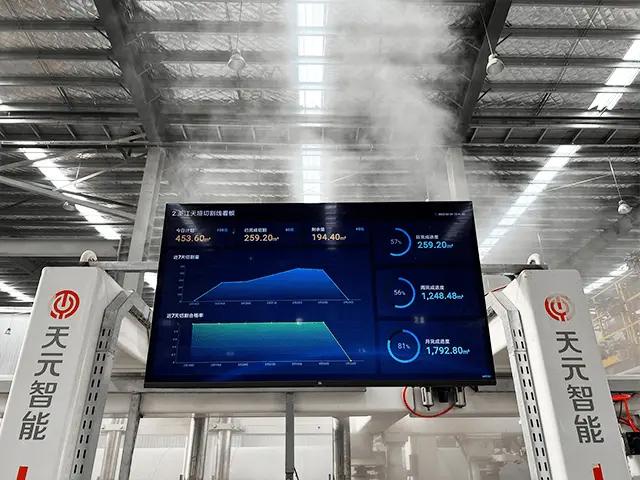
Five observable signals differentiate manufacturers with real production depth from those assembling standard equipment without the engineering foundation to optimize it:
Factory footprint and autoclave count relative to claimed output. A manufacturer claiming 300,000 m³/year capacity should have the factory size, autoclave bank, and engineering headcount consistent with that output. These are verifiable.
R&D capability and customized formulations. Local raw materials vary significantly in reactivity and composition. A capable manufacturer has an in-house laboratory and the formulation expertise to adapt the mix design for your specific inputs — rather than shipping a generic recipe.
Global project references with verified output data. Not testimonials. Actual commissioned projects with named locations and stated annual capacity. Completed plants operating at target utilization in different geographies (different climates, raw material profiles, altitude conditions) are the strongest evidence of process reliability.
DCS and MES integration on delivered lines. This is the difference between a production line that produces data and one that does not. For investors who will need to optimize plant performance post-commissioning, this capability is foundational.
Commissioning track record and post-commissioning support. Many plants underperform in the first 6–18 months due to formula tuning, operator training gaps, and equipment calibration. A manufacturer with documented commissioning expertise — the ability to bring a line from first pour to stable target capacity — protects the investor's payback timeline.
Teeyer, with more than 35 years in the AAC equipment industry, 1,200+ production lines commissioned globally across 30+ countries, and an ISO 9001:2015-certified manufacturing base, operates at the large-to-ultra-high scale tier. The company's AAC production line offerings cover 30,000 m³/year to 1,000,000 m³/year single-line configurations, with recent project completions including a 300,000 m³/year fully automated plant in Tula, Russia (2026), and a 1,000,000 m³/year super-factory project in Malaysia in partnership with Chin Hin Group.
For investors evaluating manufacturers: The factory visit, when it happens, should focus on these five signals rather than the showroom. The autoclaves, the DCS operator screens, the QC lab, and the commissioning engineer roster tell more than any capability presentation.
The gap between a manufacturer's claimed capacity and what a plant actually delivers at stable operation is where most investor surprises happen. That gap is closed by engineering depth, process discipline, and the kind of post-commissioning support that only comes from a company with a large base of operating reference plants.
Understanding factory scale, the mechanics of how capacity is calculated, and what real quality control looks like at every stage arms investors and procurement teams to ask better questions — and evaluate the answers with appropriate skepticism.
Teeyer's engineering team has commissioned 1,200+ AAC production lines across 30+ countries. Share your raw material profile, target capacity, and timeline for a tailored feasibility discussion.
Request a Quote TodayDiscuss Your Project
Considering a turnkey AAC plant investment? Teeyer's engineering team has supported over 1,200 plant projects globally. Contact them to discuss your production capacity requirements, raw material profile, and target timeline.

Empower Every Teeyer, Make Teeyer Renowned Globally!


